About art materials and children
Here are some children. Here is a basket of colourful pencils.

Art is about to happen.
The children know exactly what to do with this big basket of colourful pencils: dig with both hands. Dig right to the bottom.
The rattle of pencils is the ritual that has to come before the concentrated frowning and the murmured incantations: This is a lion. This is a lion. This is a lion. This is a tree. This is a tree. This is a tree.
Have you ever used one of those pencils?
Did you think: it’s a wonder what a child’s imagination can do, I can’t draw a THING with this?
No one can. We all tried. Some of us thought it was our fault and stopped trying.
Those are fake pencils.
The reason these children are digging through them with so much energy is because they are looking for one that works. They know to go for the shortest nubbins at the bottom of the box. Ignore the long ones, no one else got anything out of them.

They are foraging, with great determination.
Imagine what that determination could do.
When a child makes art, it’s not a case of playing pretend. It’s not like playing brain surgery with a spoon and a pudding. It’s not like feeding a plastic doll. They are not playing artist. THEY ARE ACTUALLY MAKING ART.
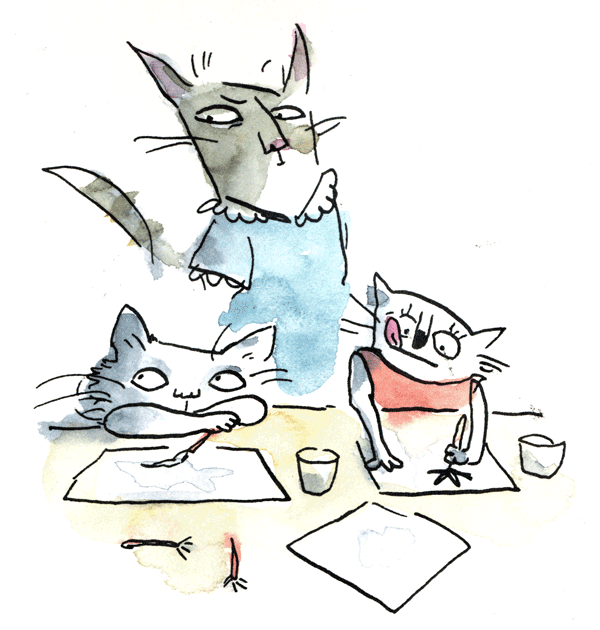
They use what they are given. They scratch faint lines, they rub puddles of chalky water across dissolving printer paper with splayed brushes. They powder fat snakes of glue with scales of confetti and glitter.
What would happen if someone gave you a bowl of confetti and some glue and told you to make art?
You might refuse. (I would.)
Children are generally good-natured enough to at least give it a try. But even the most loving guardian and the children themselves may look at the result and find it hard to see if, in fact, somehow, art has happened.
You stick it on the fridge, and you can tell what it is and everything… but is it art?

Well, it’s creative.
“Creative” often means “Wow, I’m glad I didn’t make that”.
Would you ever wish you’d made something that a child made?
Yeah… this is definitely very creative.
Maybe one day, if those children keep being creative and try very hard, some of them might even become artists…
But – who cares if they may be artists one day? What’s the point in telling them they may be artists one day if they work hard? What’s that got to do with anything? Is this whole confetti business some sort of test? Are we trying to trick them into law school or something?
It simply doesn’t matter what they will be one day.
Art is not just for artists. It’s for humans. It’s not a privilege. It’s a way to think with your hands (or your feet or your voice or your whole body, depending on the art, but we started with children and a basket of colour pencils, so pictures are trying to happen right now).
Art lets you have a good look at your thoughts, and show them to the world if you want.

You don’t need a license to make marks. You just need something that makes marks.
The joy of making pictures is more than an act of imagination. It’s physical. Your gestures made visible and permanent, the marks you make, belong to you alone, like your own body. They come before communication, before expression: they are the basis of all those things.
Give them things that leave marks. Try them out yourself. Are they enjoyable to use? Can you get a range of different marks out of them? Are they the marks you expected? Do they surprise you?
In short, do you feel like you are making something – or do you just feel like you are using something up?
Keep trying out materials. You’ll know them when you find them.
You don’t need to buy whole sets of expensive tubes of paint – or sets of anything, or anything expensive. You don’t need many different colours. Every good piece of art material unlocks endless possibilities. By good I mean anything that readily creates or receives a mark, which may include beetroot juice or a particularly well-charred stick, and the lovely white rounded cards that are used to package tights. Do professional artists paint with their breakfast tea sometimes? Of course they do, if it’s nice and strong!

Some good art materials command respect: you must wear clothes that you don’t mind staining, and you must handle them carefully. A bottle of red ink could spoil a whole carpet.
You may be surprised how much respect children can show for a powerful substance like that. Being careful for a good reason is fun, and using something that requires your supervision is exciting and memorable.
Those children like to see you deal with important substances, you know.
Art materials often need some care. Brushes need to be washed and stored carefully. Maybe the children have pets, or toys that they care about. Can they look after those? Then they can look after their tools, if you teach them.
You can give them a load of fake colourful toy paints that don’t make a mess because they don’t actually leave any traces at all – or you can let them make art.

A real brush costs no more than a pack of toy ones. A box of decent watercolours costs more than a pound shop set – get one with fewer colours. Find some bright colours that mix well, and you’ll suddenly have a whole range. Or pick just one single colour, but one that leaves a mark. Get to know that colour. Ask that colour what it can do, and you will be surprised.
By all means and of course: check if the paints are toxic. If they eat paint, they aren’t ready for paint that must not be eaten. But don’t underestimate them as they learn. If they can learn to deal with boiling water, and learn to deal with cleaning products, they can learn to deal with art materials. You’ll be there to help them with the messier ones, and find ones that are safe enough as long as the area is covered against smears and splashes.
You may well find that as soon as they are actually making marks that are meaningful to them, the children won’t be anywhere near as messy as you fear because they won’t have to make up in dramatic performance and make-believe for what the material denies them in actual experience.

They will WANT to make something beautiful rather than just have a play-time with colourful sticks that are better for throwing than drawing with.
Maybe you don’t have a budget for art materials. Don’t forget about all the good stuff you can just use for free. If you have a pair of scissors and some paper glue, anything colourful in your paper recycling may be a collage picture waiting to happen. A felt-tip pen and some scrap paper is better than that whole basket of useless crayons.
One last thing: Don’t just hand everything over to the children. Why should they have all the fun and education? Make some art together. And I mean: each make their own piece. If the materials work, you probably won’t need to help them to make it look good any more. Of course you can also collaborate on things, that’s part of the fun. But above all, respect each other’s art: you make your thing, they make theirs. You will find that you can teach one another a lot.
It’s amazing what a child’s imagination can do – but don’t let them imagine that they can’t make art.
Make those fake pencils into a tiny fence for a herd of amazing beasts painted with tea stains and thumb prints, pink highlighters and ink.
Art is about to happen.
Don’t miss out.

This is a repost of an article I wrote some years ago.